When we talk about digital transformation, the conversation usually starts with cloud platforms, digital identity, AI, cybersecurity, online services or data.
But digital transformation actually starts somewhere more basic:
Reliable electricity.
Without dependable power, almost every layer of a modern digital economy becomes harder and more expensive to build. Data centres need it. Telecom networks need it. Banks and payment systems need it. Businesses, hospitals, schools, government services and increasingly our homes depend on it.
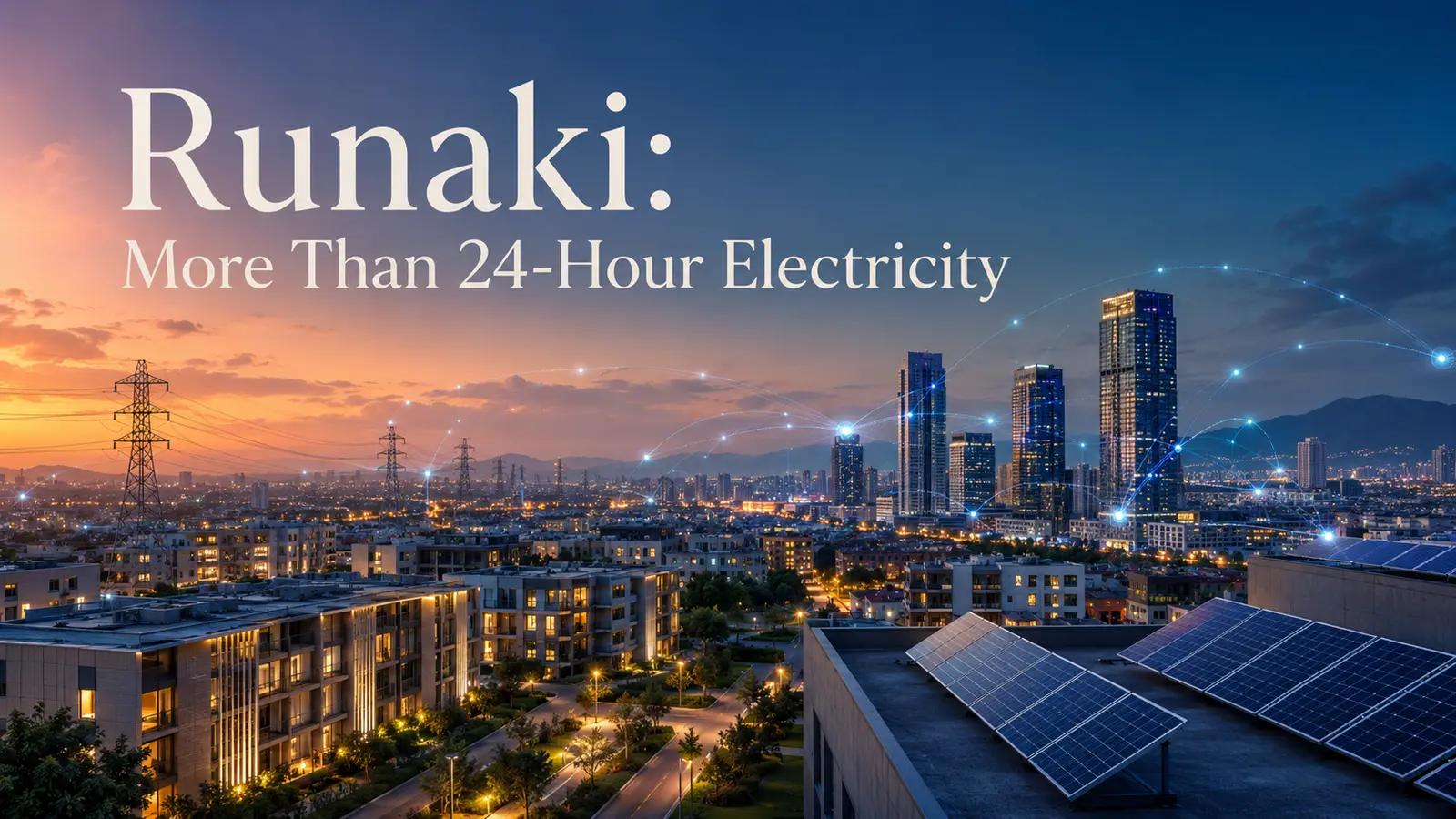
This is why I believe the Runaki project should be viewed as much more than an electricity-sector reform.
It is becoming part of the foundational infrastructure for Kurdistan's next stage of development.
From fragmented electricity to one system
For decades, electricity for many households and businesses effectively came from multiple systems: the national grid, neighbourhood diesel generators and, increasingly, private solar or battery solutions.
That fragmentation had consequences beyond inconvenience.
It increased costs, made consumption difficult to understand and manage, created significant noise and air pollution, and forced households and businesses to maintain parallel solutions simply to achieve reliable electricity.
Runaki is beginning to change that structure.
The programme aims to provide affordable 24-hour electricity across the Kurdistan Region by the end of 2026. According to the latest published Runaki figures, more than 90% of the Kurdistan Region now has access to 24-hour electricity.
The scale of the transition is already substantial. Runaki reports that approximately 5.5 million citizens have been switched to 24-hour electricity, while more than 5,900 neighbourhood diesel generators have been phased out.
That alone represents a major infrastructure transformation.
But the wider consequences may prove even more important.
Electricity is infrastructure for digital infrastructure
Modern digital systems rarely operate in isolation.
Cloud infrastructure, data centres, telecommunications, digital-government platforms, electronic payments, AI systems, smart buildings and connected services all depend upon electricity being reliable enough that organisations do not need to design their entire technology architecture around power interruptions.
Reliable electricity therefore reduces a hidden cost of digitalisation.
Businesses can invest more confidently in technology. Government can expand digital services with greater certainty. Homes and offices can depend increasingly on connected devices and digital platforms.
Even relatively simple improvements become meaningful at scale.
When electricity becomes predictable, technology planning becomes more predictable too.
This is why Runaki should also be seen through a digital-transformation lens.
It is infrastructure beneath the infrastructure.
An important environmental transition
There is another immediate consequence.
The gradual disappearance of neighbourhood diesel generators can significantly improve the environmental quality of our cities.
Runaki estimates that phasing out 5,917 generators represents approximately 1.13 million tonnes of avoided CO2 emissions annually.
The impact is not limited to carbon emissions.
Anyone who has lived in our cities understands the accumulated effects of thousands of diesel generators operating inside residential neighbourhoods: noise, fumes, maintenance, fuel transportation and local air pollution.
Removing that parallel electricity system therefore has a direct quality-of-life benefit.
But there may also be another, less obvious environmental effect.
Runaki could help accelerate solar adoption
Over the past year, through conversations and observations around the solar-energy market, I have noticed something interesting.
Before Runaki, the economic decision to install solar was often unnecessarily complicated.
A household could invest in a solar system and still remain financially tied to several electricity sources: the national grid, a neighbourhood generator and the solar installation itself.
In other words, even after making a substantial investment in renewable energy, the customer could continue paying into several parallel systems.
Runaki simplifies that equation.
With reliable, metered electricity from one primary network, households can understand their consumption more clearly and decide how much electricity they want to purchase from the grid versus produce themselves.
The progressive tariff structure reinforces this behaviour because electricity consumption becomes visible and economically meaningful. Runaki says around 80% of households, particularly lower-income households, currently pay less than they previously paid for the national grid and neighbourhood generators combined.
This creates a potentially healthier environment for solar investment.
Solar no longer needs to be considered primarily as an emergency backup solution.
It can increasingly become an energy-management decision.
A homeowner can ask:
- How much electricity do I consume?
- How much do I want to purchase from the grid?
- How much could I generate from my rooftop?
- Would batteries make economic sense?
That is a considerably more mature energy market.
From consumers to active participants
This is where the long-term opportunity becomes particularly interesting.
Reliable electricity, modern metering and widespread solar adoption can eventually create the foundation for a much more sophisticated energy ecosystem.
Over time, Kurdistan could explore greater integration of rooftop solar, battery storage, smart meters, demand management and distributed generation.
And, when the regulatory and technical environment is ready, mechanisms such as net metering or other forms of grid-connected renewable generation could become part of that discussion.
Those are future policy choices, not automatic consequences of Runaki.
But Runaki makes such conversations considerably more realistic.
A fragmented electricity system built around thousands of independent diesel generators could never easily support an advanced distributed-energy market.
A modern, metered and reliable grid potentially can.
The larger lesson
Infrastructure projects are sometimes judged too narrowly by their immediate output.
For Runaki, that output is straightforward: reliable 24-hour electricity.
But the more important question may be:
What becomes possible because reliable electricity now exists?
- More competitive businesses.
- More dependable digital services.
- Better conditions for technology investment.
- Lower dependence on diesel generators.
- Greater ability for citizens to manage electricity consumption.
- And potentially, faster adoption of renewable energy.
This is why I believe Runaki should ultimately be evaluated not simply as an electricity programme, but as one of the enabling foundations of a more digital, productive and environmentally sustainable Kurdistan.
Major transformation programmes also remind us that technology and infrastructure alone are rarely enough. Sustained political support, institutional coordination and disciplined implementation are equally important.
The next challenge should therefore be to build on this infrastructure.
Because providing electricity 24 hours a day is an important achievement.
What Kurdistan builds on top of those 24 hours may matter even more.
Reference sources
Runaki official website
https://runaki.gov.krd/en/
Half of Runaki households billed less than 38,000 IQD in May cycle
https://runaki.gov.krd/en/resources/eng_half-of-runaki-households-billed-less-than-38-000-iqd-in-may-cycle/
Nearly 5.5 million citizens now enjoy 24-hour electricity through the Runaki initiative
https://runaki.gov.krd/en/resources/nearly-55-million-citizens-now-enjoy-24-hour-electricity-through-the-runaki-initiative/
Runaki: 3 billion dinars in discounts credited to households
https://runaki.gov.krd/en/resources/eng_runaki-3-billion-dinars-in-discounts-credited-to-households/
Archive note: Prepared as a reference copy of the Runaki thought-leadership article published in October 2026. The solar-adoption discussion reflects analytical observation and is not presented as an official Runaki programme claim.